Separate the light
Interference and a stellar reference help disentangle a faint companion from its much brighter host.
How it works →EXOPLANETS · INTERFEROMETRY · VLTI
ExoGRAVITY uses the GRAVITY instrument at the Very Large Telescope Interferometer to study the orbits and atmospheres of giant exoplanets and brown dwarf companions.
Image: ESO/G. Hüdepohl (atacamaphoto.com)
What can the light and motion of distant companions tell us about their origins?
ExoGRAVITY brings together the GRAVITY and exoplanet communities to study planets and brown dwarfs close to their host stars. By combining the light from the Very Large Telescope Interferometer (VLTI), GRAVITY can separate a faint companion's signal from starlight and measure both its position and its near-infrared spectrum.
Interference and a stellar reference help disentangle a faint companion from its much brighter host.
How it works →Precise relative positions reveal orbital motion and help constrain masses and system architecture.
Explore astrometry →Spectra reveal molecular features and let us test models of clouds, chemistry and evolution.
Explore spectra →Four telescopes, one much sharper view.
The VLTI combines light from telescopes separated by baselines of up to about 130 metres. Their light forms interference fringes: the pattern encodes spatial information at a resolution set by the baseline, rather than by a single telescope.
In GRAVITY's dual-field mode, one channel tracks fringes on the bright star while a second observes the companion. Single-mode fibres reduce the starlight entering the companion channel; the remaining stellar contribution is modelled and removed using its different interferometric phase. The result is a measurement of the companion's position and spectrum, not a conventional photograph of its surface.
The method still has limits: fibre alignment, imperfect stellar subtraction and calibration can introduce systematic errors. Careful calibration and repeated observations are essential.
The HR 8799 e demonstration →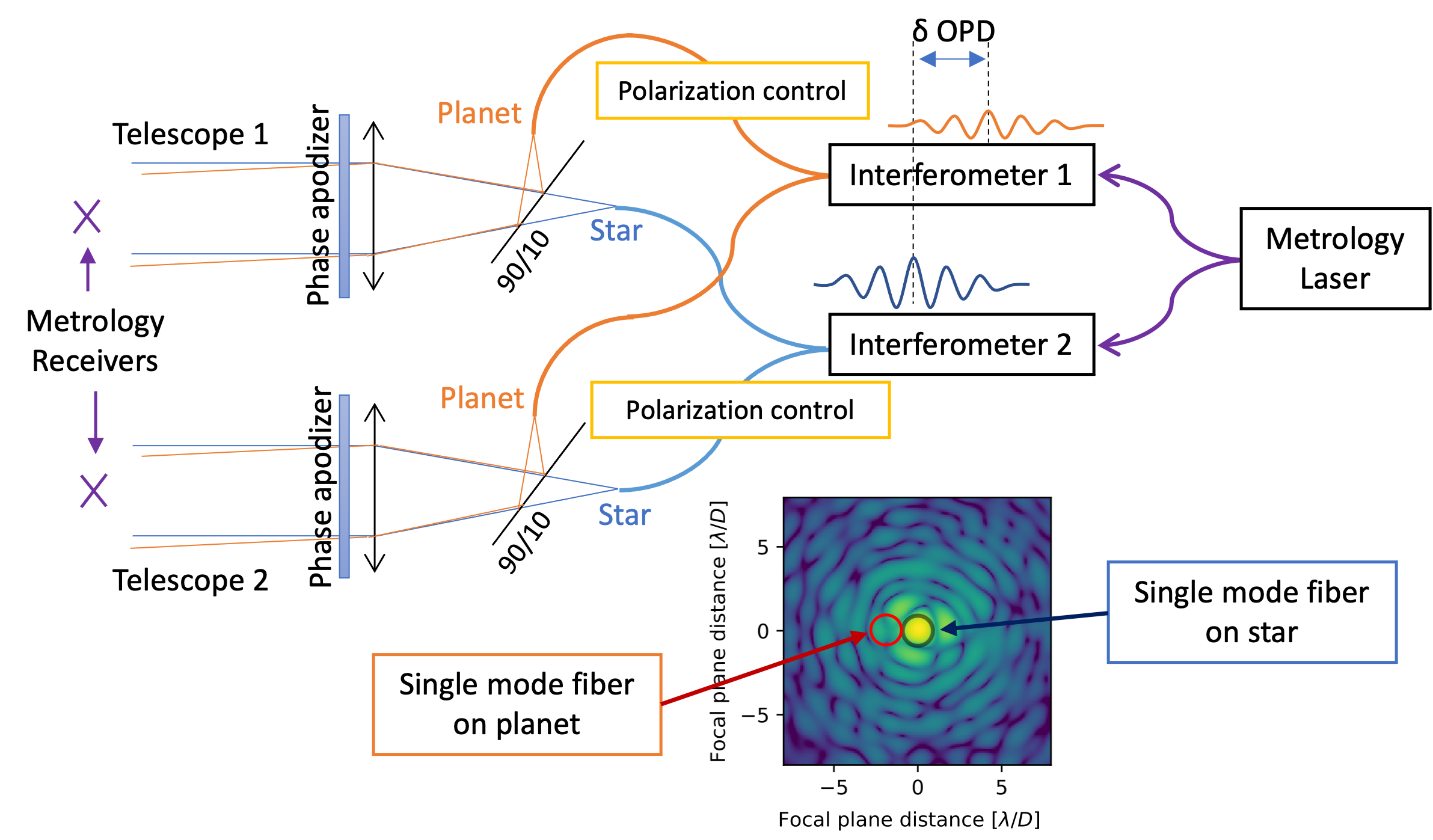
Measuring tiny changes in position reveals how planetary systems move.

The interferometric phase measures a companion's position relative to its star. For HR 8799 e, the first GRAVITY detection reached a precision of roughly 100 microarcseconds, constraining its orbit and disfavoring the perfectly coplanar stable solutions considered in that study.
For the young PDS 70 system, measurements of both planets combined with earlier imaging and stability calculations found an orbit for PDS 70 b with eccentricity 0.17 ± 0.06, while c was consistent with a nearly circular orbit. Their orbits were consistent with a 2:1 resonance, but did not establish that they are resonant. The stability analysis placed a 95% upper limit of 10 Jupiter masses on b; it did not constrain c's mass.
Across populations, eccentricity can also test ideas about formation and later dynamical interactions. An ongoing manuscript finds that planetary-mass companions and known multi-companion systems tend towards lower eccentricities than brown dwarfs and single-companion systems in its sample. This is consistent with different formation or dynamical histories, but the analysis and its interpretation remain preliminary.
Read the PDS 70 study →A spectrum separates light by wavelength, revealing the fingerprints of an atmosphere.
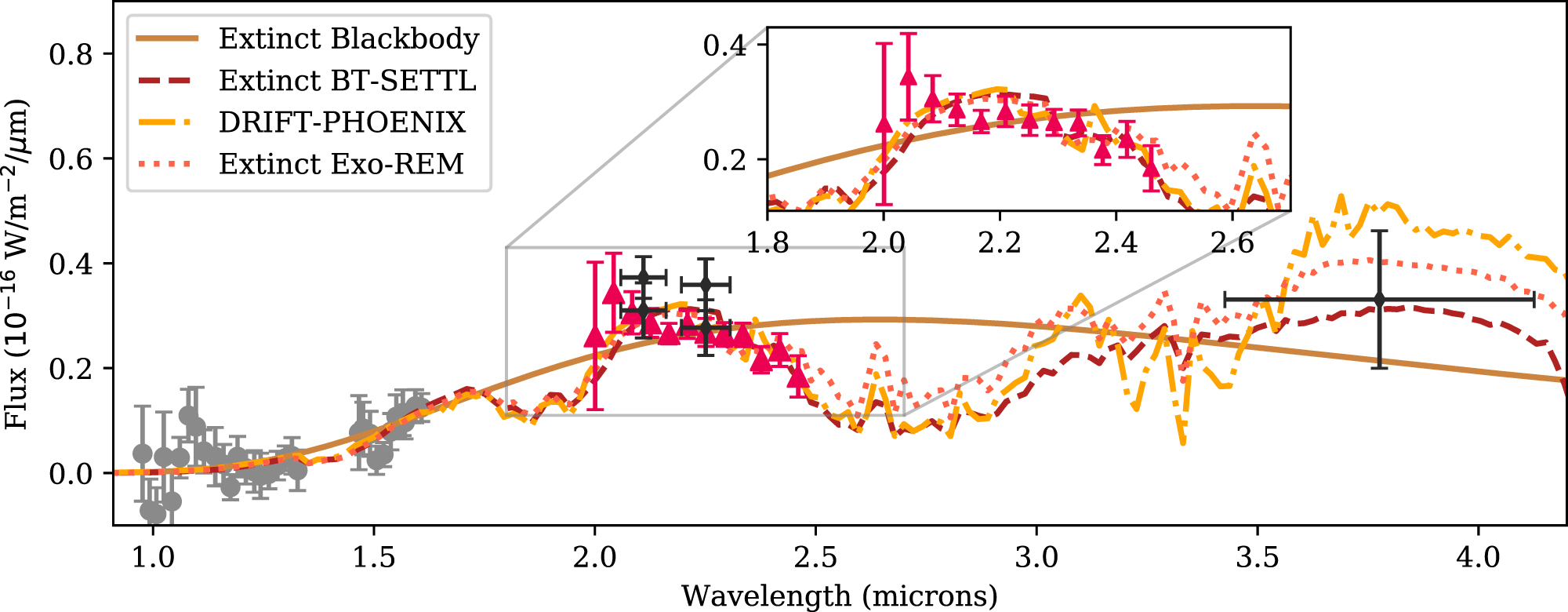
GRAVITY observes near-infrared K-band light, approximately 2.0–2.4 micrometres in the spectral library. Features of water, carbon monoxide and methane help researchers investigate atmospheric chemistry and clouds. For young, self-luminous companions, the measured light is primarily thermal emission.
The ExoGRAVITY Spectral Library uniformly reprocesses spectra of 39 giant planet and brown dwarf companions at a resolving power of about 500. It spans late-M to late-T spectral types, including the transition from CO-dominated to methane-dominated spectra.
The library's model-derived luminosities have a typical uncertainty of about 0.15 dex including systematics. K-band spectra alone constrain temperatures and radii less well, and typical epoch-to-epoch flux variations of about 10% are attributed mainly to instrumental systematics.
Measurements become physical insights through models — and their assumptions matter.
Atmospheric grids and retrieval methods compare observed spectra with models of temperature, composition and clouds. Combining GRAVITY with observations at other wavelengths helps break degeneracies. Composition ratios, luminosity and dynamical mass can then be compared with formation and evolution models, but the inference depends on the data and model assumptions.
For PDS 70 b and c, the 2021 K-band spectra favoured dusty atmosphere models over pure blackbodies. The observations did not determine where the dust resides, and neither planet's circumplanetary environment was spatially resolved. Additional wavelengths are needed to distinguish atmospheric and circumplanetary emission.
From the first interferometric detection to population studies.
2019 · FIRST DETECTION
First direct detection of an exoplanet by optical interferometry, with precise relative astrometry and a K-band spectrum.
GRAVITY Collaboration · Read paper →2021 · PLANET FORMATION
Astrometry, dynamics and spectra constrain the orbits and dusty emission of two young protoplanets.
Wang et al. · Read paper →SPECTRAL LIBRARY
Uniformly reduced K-band spectra compare the atmospheres of giant planets and brown dwarf companions.
Kammerer et al. · Read paper →WORKING MANUSCRIPT · PRELIMINARY
A working manuscript finds a lower-eccentricity distribution for planetary-mass companions than for brown dwarfs, and for known multi-companion systems compared with singles. Its population-level analysis and formation interpretation are preliminary.
Explore the program bibliography ↓
These publications are listed by the ESO Telescope Bibliography as using data from program 1104.C-0651. Some also use data from other programs, and this is not necessarily a complete list of all ExoGRAVITY research. This snapshot was checked on 10 November 2026; consult ESO for the latest list.
Today's exoplanet observations and tomorrow's instrument development.
ExoGRAVITY is a collaboration using GRAVITY to study exoplanets and brown dwarfs. PLANETES is a separate ERC project developing high-contrast J-band interferometry at the VLTI. It builds on dual-field interferometry experience, upgrades PIONIER, and plans to use GRAVITY for fringe tracking and pupil stabilization.
The two efforts share scientific goals and interferometric expertise, but PLANETES is an instrument-development project, not another name for ExoGRAVITY.
Discover PLANETES →Resources for exploring observations and models.
Combined and individual-epoch spectra, stellar references and covariance information.
Explore the data →Visualise the predicted positions of directly imaged planets.
Visit the tool →Fit orbits using astrometric and other observations.
Read the documentation →Compare substellar spectra and photometry with atmospheric and evolutionary models.
Read the documentation →Compute spectra and perform atmospheric retrievals.
Read the documentation →The ExoGRAVITY collaboration's code of conduct.